
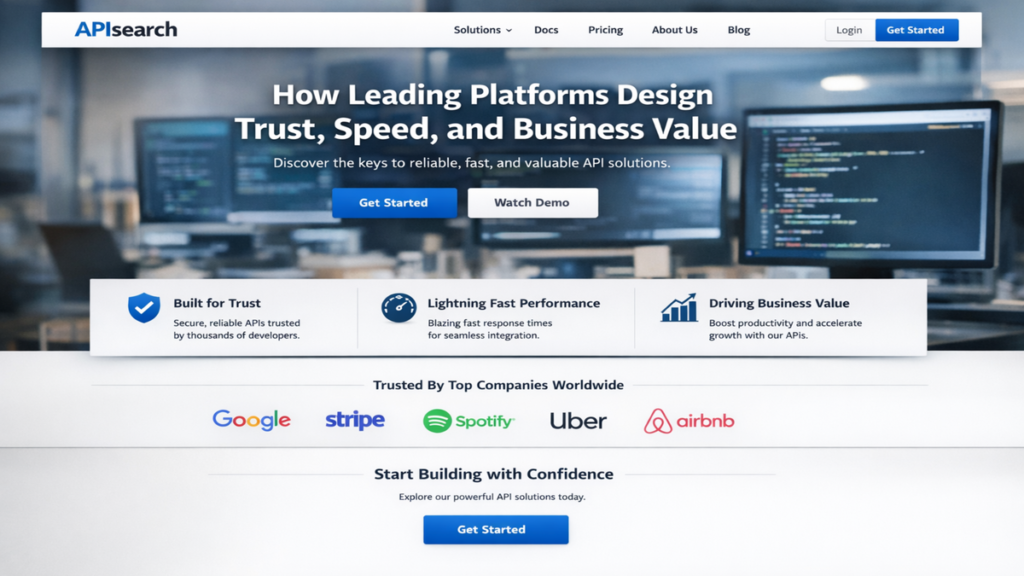

I approach the idea of the best api search company’s homepage as more than a marketing surface. It is often the first technical document a developer reads and the first business signal a decision maker interprets. Within the first screen, users expect clarity on speed, relevance, pricing logic, and integration effort. If those signals are missing, the platform usually fails the evaluation before a demo ever happens.
In practical terms, a homepage for a search API company must satisfy two audiences at once. Developers want proof of performance, clean documentation paths, and confidence that the system will not break at scale. Business leaders want to understand cost predictability, security posture, and long term viability. When both groups arrive at the same page, the design choices become a strategic balancing act rather than a branding exercise.
Over the past decade, I have reviewed dozens of search platforms for newsroom tools, internal knowledge bases, and commerce systems. In those evaluations, the homepage consistently acted as a filtering mechanism. It revealed whether the company understood its own product economics and its customer’s operational reality. The best api search company’s homepage does not try to impress with slogans. It demonstrates competence through structure.
This article breaks down how leading search API providers design their homepages, what signals matter most, and how those choices translate into adoption. I focus on real platforms, real design patterns, and real business implications rather than abstract theory.
What Defines a High Performing API Search Homepage
A strong homepage communicates technical value without forcing users into documentation too early. The best examples start with a concise explanation of what the API does, followed immediately by evidence. That evidence often takes the form of latency metrics, indexing speed, or relevance benchmarks.
From my experience reviewing vendor sites during procurement cycles, clarity beats cleverness every time. Pages that explain how search relevance is tuned or how indexing scales under load tend to convert better than pages that rely on generic claims. The best api search company’s homepage usually includes a short architecture overview and a visible path to technical validation.
Security and compliance also surface early. Enterprise buyers look for signals such as SOC 2, GDPR readiness, or data residency options. When these appear below the fold or only in legal pages, trust erodes quickly.
As Ryan Petersen, former search infrastructure lead at Shopify, once noted in a conference interview, “Search is invisible until it fails. Your homepage should convince people it will not.” That mindset shapes the most effective designs.
Business Signals Embedded in Homepage Structure
Beyond technology, the homepage encodes business intent. Pricing transparency is a major differentiator. Platforms that hide costs behind sales calls often slow adoption, especially among startups and small teams.
The best api search company’s homepage typically shows pricing tiers, usage based logic, or at least a calculator. This communicates confidence in the economic model. It also reduces friction for teams doing early feasibility analysis.
Another signal is ecosystem maturity. Homepages that highlight integrations with platforms like Google Cloud, Shopify, or Elasticsearch compatible tooling indicate that the company understands how search fits into broader systems. This matters for CTOs assessing migration risk.
A well structured homepage also separates use cases clearly. Ecommerce search, documentation search, and internal knowledge search have different requirements. When these are clearly segmented, users can self identify quickly.
As analyst Benedict Evans has written, “Most software buying decisions fail not on features, but on confidence.” The homepage is where that confidence is built.
Comparative Signals Across Leading Search API Providers
The table below compares common homepage signals across well known search API companies. This reflects patterns observed during vendor reviews rather than marketing claims.
| Platform Focus | Homepage Emphasis | Primary Audience Signal | Adoption Impact |
|---|---|---|---|
| Developer first APIs | Code snippets above the fold | Ease of integration | Faster trials |
| Enterprise search | Compliance badges and SLAs | Risk mitigation | Longer sales cycles |
| Ecommerce search | Relevance tuning demos | Revenue lift | Higher conversion |
| Open source backed | Architecture diagrams | Control and flexibility | Technical trust |
This structure shows how homepage priorities align with business models. The best api search company’s homepage aligns these signals intentionally rather than accidentally.
Homepage Design and Technical Credibility
Design choices influence perceived technical credibility more than many teams realize. Overly animated pages can signal marketing dominance over engineering substance. Conversely, sparse pages with clear typography often feel more trustworthy to technical users.
I have personally abandoned vendor evaluations when I could not find documentation links within two clicks of the homepage. The best api search company’s homepage always treats documentation as a core product, not a secondary asset.
Another key element is performance proof. Real numbers matter. When a homepage states average query latency or indexing throughput, it anchors expectations. Even if those numbers are conservative, they create a baseline for evaluation.
According to Martin Fowler, software architect and author, “Transparency is a design choice, not a legal obligation.” Search API companies that adopt this principle tend to win long term trust.
Evolution of Search API Homepages Over Time
Search API homepages have evolved alongside the market. Early platforms focused almost entirely on developer appeal. Modern platforms balance developer needs with enterprise governance.
| Era | Homepage Priority | Market Driver |
|---|---|---|
| 2010–2014 | Code first messaging | Developer adoption |
| 2015–2019 | Relevance and speed | SaaS competition |
| 2020–2023 | Security and scale | Enterprise expansion |
| 2024–present | AI assisted search clarity | System complexity |
The current phase emphasizes explainability. As AI powered search becomes more common, users want to understand how results are generated. The best api search company’s homepage increasingly includes plain language explanations of ranking logic and model behavior.
Expert Perspectives on Homepage Strategy
Industry voices consistently reinforce the homepage’s strategic role. April Dunford, positioning consultant, has stated, “Your homepage is your positioning document in public.” This is especially true for infrastructure products like search APIs.
From an engineering standpoint, former Google search engineer Matt Cutts once explained in a public talk that “Relevance is earned through iteration, not claims.” Homepages that reflect this humility often resonate more with experienced developers.
Finally, venture capitalist Tomasz Tunguz has noted that usage led growth depends heavily on self service onboarding. A homepage that enables that journey without friction directly impacts revenue efficiency.
These perspectives align on a single point. The homepage is not decoration. It is infrastructure for decision making.
Takeaways
- The best api search company’s homepage functions as both technical overview and business filter
- Clear performance metrics build trust faster than branding language
- Pricing transparency accelerates adoption across company sizes
- Documentation visibility signals engineering maturity
- Design restraint often increases perceived credibility
- Homepage structure reflects underlying business model
- Explainability is becoming essential as AI search grows
Conclusion
I see the best api search company’s homepage as a compressed version of the company itself. In a few screens, it reveals how the platform thinks about users, systems, and economics. When done well, it answers most early questions before they are asked.
For developers, it should feel like an invitation to experiment without risk. For business leaders, it should communicate stability and strategic fit. Balancing those needs is difficult, which is why only a handful of platforms consistently get it right.
As search APIs become more embedded in products, from commerce to internal tools, the homepage will continue to shape market perception. Companies that treat it as a living system rather than a static asset tend to adapt faster.
In evaluating search platforms, I recommend spending time on the homepage with intention. It often tells you how the company will behave once you depend on its infrastructure.
Read: https://claudemagazine.com/technology/adovivo-com/
FAQs
What makes the best api search company’s homepage effective?
It clearly explains technical value, shows performance evidence, and provides fast access to documentation and pricing without forcing sales contact.
Should a search API homepage target developers or executives?
Both. The best designs separate messaging paths so each audience can quickly find relevant information.
Why is pricing visibility important on a search API homepage?
Transparent pricing reduces evaluation friction and signals confidence in the platform’s economic model.
How does AI change homepage expectations for search APIs?
AI increases demand for explainability. Users want to understand how relevance and ranking decisions are made.
Can homepage design influence enterprise adoption?
Yes. Security signals, compliance information, and architectural clarity strongly affect enterprise trust.
References
Evans, B. (2023). The confidence gap in enterprise software. https://www.ben-evans.com
Fowler, M. (2019). Transparency in software architecture. https://martinfowler.com
Tunguz, T. (2022). Usage led growth and self service SaaS. https://tomtunguz.com