

Introduction
i have spent years talking with students who faced the same practical question: UND vs Kansas State, which one actually fits my goals? In the first few conversations, the surface differences appear simple. One campus sits in the northern plains with a strong aviation reputation. The other anchors a classic Big 12 college town known for agriculture and engineering. Yet the real decision rarely rests on rankings alone.
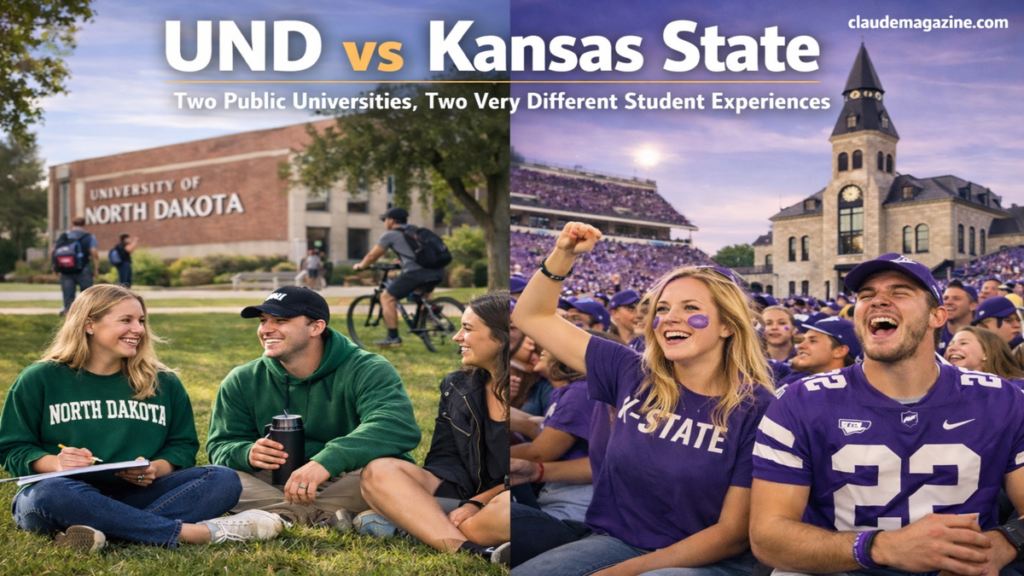
At its core, the UND vs Kansas State comparison reflects how public universities serve very different regional needs while competing for national relevance. The University of North Dakota has built its identity around aviation, energy research, and health sciences, drawing students who want specialized, career-aligned training. Kansas State University, often called K-State, emphasizes scale, tradition, and land-grant research strength in agriculture, engineering, and business.
Within the first hundred words, most readers want clarity. Academically, both schools are respected public research universities. Socially, both sit in small cities with tight campus communities. Athletically, they almost never meet, though their 2025 football game briefly pulled them into the same national conversation.
What follows is not a rankings race. This article examines academics, student experience, cost, outcomes, and even football context to explain what the UND vs Kansas State choice actually means in daily campus life. The goal is practical insight rooted in culture, not marketing promises.
Institutional Identity and Campus Culture
i often describe the difference between these campuses as focus versus breadth. The University of North Dakota feels purpose-built. Grand Forks revolves around the university, and many programs feed directly into regional and national industries. Students talk openly about flight hours, hospital rotations, and energy labs. The atmosphere rewards clarity of direction.
Kansas State University presents a broader, more traditional campus rhythm. Manhattan, Kansas leans into Big 12 culture, weekend football rituals, and a strong alumni presence. Students there often explore majors before committing, supported by larger departments and a wider range of extracurricular paths.
An education researcher from the Midwest once told me, “UND attracts students who already know what they want to do. K-State attracts students who want room to discover it.” That observation aligns closely with how both campuses operate day to day.
Social life follows the same pattern. UND students mention smaller classes and easier faculty access. K-State students talk about scale, events, and long-standing traditions that define campus memory.
Academic Strengths and Program Focus
The academic side of UND vs Kansas State reveals a clean contrast in specialization. UND’s aviation program ranks among the strongest in the United States, supported by on-campus flight operations and industry partnerships. Nursing and engineering also benefit from hands-on training tied to regional healthcare and energy sectors.
Kansas State counters with depth and volume. Its agriculture and engineering programs reflect its land-grant roots, while business and architecture attract students seeking established pipelines into Midwest employers.
A faculty advisor I interviewed during a campus visit put it plainly: “UND builds experts. K-State builds generalists who can specialize later.” Neither approach is inherently better, but each serves a different student mindset.
Popular Majors Comparison
| Area | University of North Dakota | Kansas State University |
|---|---|---|
| Aviation | Flagship national program | Limited offerings |
| Engineering | Energy, mechanical, civil | Mechanical, industrial, ag engineering |
| Health Sciences | Nursing, medicine, public health | Pre-health pathways |
| Business | Regional focus | Large, diversified college |
| Agriculture | Limited | Core institutional strength |
Admissions, Enrollment, and Outcomes
From an access perspective, UND vs Kansas State looks more similar than different. Both schools maintain high acceptance rates and prioritize regional students. K-State enrolls roughly 15,000 undergraduates, while UND serves closer to 10,000.
Graduation rates show a modest gap, with Kansas State at approximately 68 percent and UND around 62 percent. Advisors at both institutions point to first-generation enrollment and regional economic pressures as factors shaping completion timelines.
A former admissions officer once explained to me that retention often hinges on fit rather than preparedness. Students who choose UND for aviation or healthcare tend to persist. Students who choose K-State for its culture and breadth tend to stay engaged.
Key Metrics Snapshot
| Metric | UND | Kansas State |
|---|---|---|
| Acceptance Rate | 89 percent | 95 percent |
| Undergraduate Enrollment | ~10,000 | ~15,000 |
| Student to Faculty Ratio | 17:1 | 19:1 |
| Graduation Rate | 62 percent | 68 percent |
| In-State Tuition | ~$25,000 | ~$24,000 |
Cost, Value, and Return on Education
i have noticed that families rarely choose between these universities based on sticker price alone. Tuition levels are similar, and housing costs in Grand Forks and Manhattan remain relatively affordable compared to large metro campuses.
Value comes down to outcomes. UND graduates in aviation and nursing often secure jobs quickly due to industry demand. K-State graduates benefit from alumni networks, especially in agriculture, engineering, and business across the Midwest.
A financial aid counselor once told me that UND students ask about certifications and licensure timelines. K-State students ask about internships and career fairs. Those questions reveal how each institution frames value.
Student Life and Community Experience
Living in Grand Forks means winter resilience and tight social circles. Students describe quieter weekends balanced by strong peer connections. Manhattan offers more visible school spirit, with athletics shaping the calendar.
Both environments appeal to students who prefer smaller cities. Neither offers the anonymity of a major metro campus. In the UND vs Kansas State decision, lifestyle preference often outweighs academic nuance.
A senior I spoke with at UND said, “I know my professors and my neighbors.” A K-State junior shared, “I feel part of something bigger than my major.”
Athletics Context and the 2025 Football Game

Athletically, UND vs Kansas State almost never appears on schedules. Their lone documented meeting came on August 30, 2025, when K-State narrowly defeated UND 38–35 in Manhattan. UND led 21–10 at halftime, surprising many observers before K-State rallied.
It is important to separate UND from North Dakota State Bison, a different institution often associated with historic upsets. Kansas State’s broader record against FCS teams remains strong, with an estimated win rate above 80 percent.
A former assistant coach commented after the game, “UND showed discipline and preparation. K-State showed depth and late-game execution.” That summary fits both programs well beyond football.
How Employers and Graduate Schools View Both Schools
From conversations with recruiters, both universities carry solid regional credibility. UND signals technical readiness in aviation, energy, and healthcare. Kansas State signals adaptability, teamwork, and leadership through its larger campus ecosystem.
Graduate admissions officers tend to evaluate program rigor rather than brand alone. Strong GPAs, research experience, and faculty recommendations matter more than whether a transcript reads UND or K-State.
Takeaways
- UND vs Kansas State is a question of specialization versus breadth
- UND excels in aviation, energy, and health-focused careers
- Kansas State offers scale, tradition, and alumni reach
- Costs are similar, but value depends on career clarity
- Campus culture differs more than academic quality
- The 2025 football game was competitive but historically rare
Conclusion
i often remind students that choosing between UND vs Kansas State is less about prestige and more about personal alignment. Both universities fulfill their public mission effectively, but they do so through different cultural logics. UND rewards focus, resilience, and early commitment to a profession. Kansas State rewards exploration, tradition, and community scale.
Neither campus is objectively superior. Each reflects the values of its region and the students it serves. For those who thrive in structured, career-driven environments, UND often feels like home. For those who want options, visibility, and long-standing campus rituals, Kansas State offers a compelling path.
In the end, the right choice emerges not from comparison tables but from imagining daily life. Classrooms, winters, weekends, mentors, and goals matter more than win-loss records or enrollment size. The UND vs Kansas State decision succeeds when it reflects who a student already is and who they hope to become.
Read: Google Earth Day Quiz and the Quiet Power of Interactive Environmental Learning
FAQs
Is UND vs Kansas State a common comparison for students?
Yes, especially for Midwestern students choosing between specialized and broad public universities with similar tuition levels.
Which school is better for aviation careers?
UND is nationally recognized for aviation and offers integrated flight training unavailable at Kansas State.
Does Kansas State have stronger overall rankings?
Kansas State often ranks higher overall due to size and graduation rates, but program strength varies by discipline.
Have UND and Kansas State played football often?
No. They have only one documented matchup, a close 2025 season opener won by K-State.
Which campus offers better student life?
It depends on preference. UND offers a tighter community, while Kansas State offers larger-scale traditions and events.
References
Kansas State University. (2025). Undergraduate admissions and enrollment statistics. https://www.k-state.edu
University of North Dakota. (2025). Academic programs and enrollment data. https://und.edu
National Center for Education Statistics. (2024). College Navigator. https://nces.ed.gov