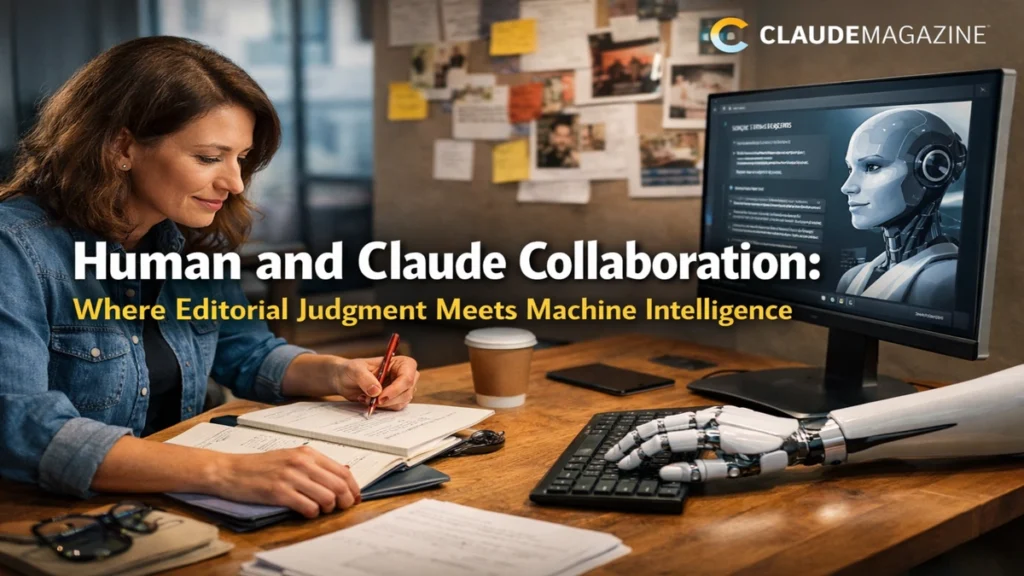

I have spent years watching tools promise to replace human judgment, and just as many years watching those promises quietly fall apart in real world use. The latest generation of AI systems feels different, not because they eliminate human work, but because they force us to redefine it. Human and Claude collaboration sits at the center of that shift. Instead of asking whether machines can think, the better question is how people think alongside them, and where responsibility ultimately lives.
In the first moments of using Claude, the value becomes obvious. It reads fast, synthesizes huge volumes of material, and produces coherent drafts with impressive speed. Yet that speed alone does not make work publishable, shippable, or trustworthy. What matters is what happens after the draft appears on the screen. Editors, engineers, researchers, and policymakers step in, shaping tone, checking assumptions, correcting subtle errors, and deciding what should exist in the world at all.
This article explores where that boundary lies. It explains how roles divide naturally between Claude and humans, how editorial judgment operates on top of machine output, and why oversight remains a design principle rather than a bureaucratic afterthought. I will also walk through practical workflows that teams are converging on, especially in software development, where Claude Code has become a reasoning partner rather than an autonomous actor. The goal is not to celebrate automation, but to understand collaboration as a disciplined craft that preserves human voice, accountability, and taste.
Understanding Human and Claude Collaboration
I tend to think of Claude less as a replacement and more as a high bandwidth reasoning surface. It absorbs instructions, codebases, documents, and constraints, then reflects them back in structured form. The collaboration works because the machine and the human operate at different layers of judgment. Claude excels at expansion, synthesis, and reorganization. Humans excel at meaning, consequence, and responsibility.
At its best, this partnership mirrors long standing editorial workflows. A junior writer drafts quickly, offering structure and ideas. A senior editor shapes the work, deciding what matters, what feels right, and what meets ethical and institutional standards. Claude simply accelerates the first phase to an unprecedented degree.
An AI researcher once described this dynamic succinctly. “Speed is not intelligence,” she said. “Judgment is.” Another editor framed it differently. “Claude gives me clay,” he noted. “I still decide what the sculpture is.” These perspectives reveal why collaboration succeeds only when humans retain authority over framing and final decisions.
Read: Claude as a Reasoning System: From Prompt Interpretation to Structured Output
Roles in the Collaboration
The division of labor between humans and Claude is surprisingly consistent across domains. Each side contributes distinct strengths that rarely overlap.
| Role | Primary Strengths | Typical Outputs |
|---|---|---|
| Claude | Fast synthesis, drafting, structured reasoning | Drafts, summaries, comparisons, code diffs |
| Humans | Judgment, ethics, taste, accountability | Final edits, approvals, publication decisions |
Claude operates comfortably in ambiguity during early stages. It can propose multiple approaches, outline arguments, or sketch system designs without committing to one path. Humans then choose which path aligns with goals, values, and constraints.
One product leader described the balance clearly. “Claude explores the map,” he said. “We choose the destination.” That separation prevents over reliance on machine output while still benefiting from its breadth.
Editorial Judgment on Top of AI Drafts
Editors who work with Claude quickly learn to treat its output as provisional. The draft is not sacred. It is material. Trimming, rearranging, rewriting, and fact checking are expected, not exceptional.
This approach preserves human voice. Even when Claude writes fluent prose, subtle signals like emphasis, pacing, and cultural context require human sensitivity. A sentence can be technically correct yet misleading in implication. Editors catch those moments.
A senior editor at a digital publication put it bluntly. “Claude gets me to eighty percent fast,” she said. “My job is deciding whether that eighty percent should exist at all.” Another editor emphasized accountability. “If something is wrong, my name is on it, not the model.”
This mindset prevents the erosion of responsibility. Claude accelerates thinking, but humans remain answerable for outcomes.
Human in the Loop Controls and Oversight
Oversight is not just a social norm. It is embedded into how Claude is designed and deployed by Anthropic. The system is trained to invite review, flag uncertainty, and defer on risky actions.
In agent based workflows, Claude can analyze situations and propose actions, but humans approve steps that affect production systems, data integrity, or security. This design mirrors safety critical industries where automation assists but does not overrule human operators.
| Area | Claude Capability | Human Authority |
|---|---|---|
| Code changes | Propose diffs | Approve and merge |
| System config | Analyze impacts | Apply changes |
| Content publishing | Draft material | Decide publication |
A governance expert summarized the philosophy well. “The machine should feel comfortable asking permission,” he said. “That is a feature, not a limitation.”
Practical Workflows Where Collaboration Shines
I have seen this pattern repeat across disciplines. In content production, Claude drafts articles, FAQs, and documentation. Humans refine narrative arc, manage legal risk, and ensure clarity. In coding, Claude suggests designs, refactors, and tests. Engineers decide architecture, run validation, and own reliability.
Research and policy work reveals the deepest contrast. Claude aggregates sources and outlines positions efficiently. Humans weigh social impact, institutional constraints, and long term consequences. One policy analyst explained it simply. “Claude shows me the terrain. I decide where we stand.”
These workflows succeed because they respect boundaries. Claude is a reasoning and drafting engine. Humans own taste, ethics, and accountability.
Preparing a Project for AI Collaboration
Before pairing with Claude Code, teams increasingly focus on making projects legible. I like to think of this as setting the table before dinner. The clearer the context, the better the collaboration.
A common practice is adding a CLAUDE.md file at the repository root. This document explains the tech stack, build commands, test strategy, and non negotiable constraints. It also sets behavioral expectations for Claude, such as analyzing before editing or preferring small diffs.
Projects that build cleanly collaborate more smoothly. Flaky tests and unclear architecture create noise. Teams also decide branching strategies early, often using one feature branch per Claude assisted effort. This structure reduces friction and keeps humans in control.
Framing the Task and Scope
When work begins, experienced users avoid vague prompts. Instead of asking for help, they define intent and boundaries. They describe the goal, constraints, and where Claude should look first.
Crucially, they often ask for analysis before action. Requests like “summarize how this module works” or “map the data flow” encourage Claude to build a mental model. That shared understanding prevents reckless edits and builds trust.
This phase feels less like commanding a tool and more like onboarding a collaborator. The human sets direction. Claude listens and reflects.
Shared Understanding and Design
Once Claude has explored relevant files, collaboration shifts into design. Claude proposes an implementation plan with step by step changes, affected files, and potential risks. Humans then review, annotate, and challenge that plan.
I see this as the most important checkpoint. Pushing back here is cheap. Fixing architectural mistakes later is not. Engineers often ask for alternatives when proposals feel risky or misaligned with domain constraints.
This dynamic mirrors pair programming with a capable but inexperienced teammate. The human curates the plan before execution begins.
Iterative Coding and Reviewable Diffs
Actual coding happens in small, inspectable increments. Claude implements limited steps and shows diffs rather than replacing entire files. Humans review each change in their editor, run tests, and request revisions.
This loop keeps quality high and surprises low. One engineer described the rhythm. “Claude types fast,” he said. “I read slow.” That asymmetry is intentional.
By insisting on small diffs, teams maintain control and preserve code history that future humans can understand.
Testing, Validation, and Safety Nets
Testing is not an afterthought in effective collaboration. Claude can generate unit tests, suggest edge cases, and outline manual QA steps. Humans decide which tests matter and which add noise.
The machine offers breadth. The human enforces relevance. This balance reduces blind spots without bloating test suites.
A quality engineer noted, “Claude reminds me of failure modes I forget. I decide which ones are real risks.”
Multi Agent Review Patterns
Some teams add an extra layer by using a second Claude pass as a reviewer. One instance builds. Another critiques. Humans then decide what feedback to apply.
This separation approximates human pull request workflows. It catches issues a single pass might miss and reinforces the idea that no single output is authoritative.
Documentation and Knowledge Capture
Claude also shines in documentation. It can draft READMEs, architecture summaries, and onboarding notes quickly. Humans then align tone with internal conventions and ensure accuracy.
Over time, this practice reduces institutional knowledge loss. Documentation improves not because humans write more, but because they edit better starting points.
Final Review and Merge
Before merging, humans run full test suites, review AI assisted changes, and clean commit history. This stage is custodial. It decides what becomes part of the project’s permanent record.
One engineering manager framed it well. “My job is deciding what history we keep.”
Collaboration Norms for Teams
Sustainable use of Claude requires shared norms. Teams standardize CLAUDE.md files, canonical prompts, and expectations around review. They discourage auto merging and encourage transparency about where AI influenced decisions.
These norms transform Claude from a novelty into infrastructure.
Takeaways
- Claude excels at speed, synthesis, and structured drafting.
- Humans remain responsible for judgment, ethics, and taste.
- Editorial review treats AI output as material, not authority.
- Human approval gates reduce risk in sensitive workflows.
- Small diffs and iterative review preserve quality.
- Documentation improves when humans edit strong drafts.
Conclusion
I do not see human and Claude collaboration as a transitional phase on the way to automation. I see it as a stable equilibrium. The machine handles volume and variation. Humans handle meaning and consequence. Together, they produce work that neither could achieve alone.
The danger lies not in using Claude, but in surrendering judgment to it. When teams maintain clear roles, strong review habits, and explicit oversight, collaboration becomes an amplifier of human capability rather than a substitute for it. The future of knowledge work will not be decided by smarter machines alone. It will be shaped by how carefully humans choose to work with them.
FAQs
Is Claude meant to replace human editors or developers?
No. Claude accelerates drafting and analysis, but humans remain responsible for judgment, ethics, and final decisions.
Why is human oversight emphasized so strongly?
Because accountability, context, and values cannot be delegated to a machine without risk.
What makes Claude effective in coding workflows?
Its ability to understand large codebases, propose structured changes, and generate tests quickly.
How do teams avoid over trusting AI output?
By enforcing review norms, small diffs, and human approval gates.
Can this collaboration model scale across organizations?
Yes, when shared norms and documentation make expectations clear.