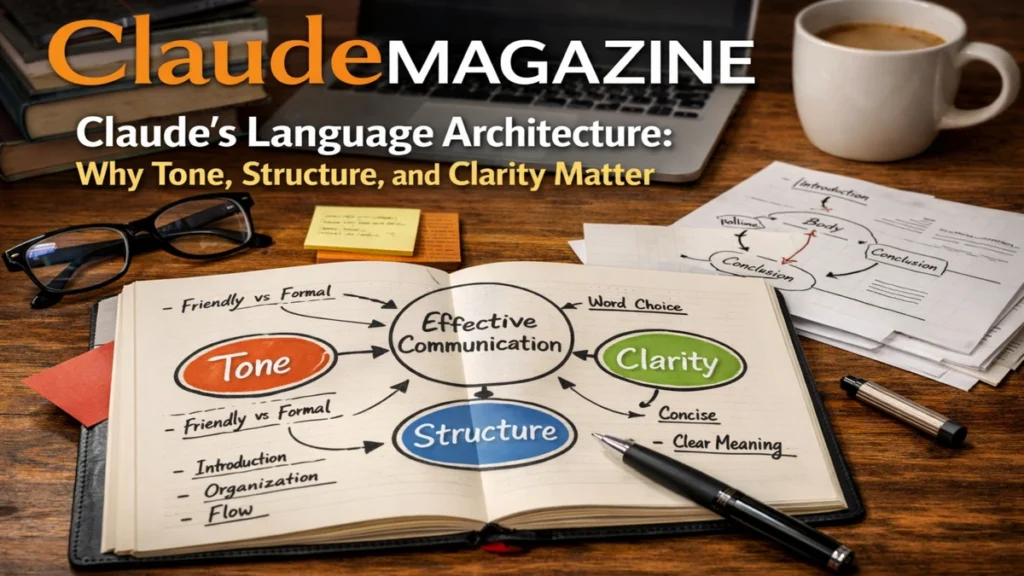

i used to think “tone” was the wrapper around the real work. Then I watched how modern AI assistants succeed or fail in the moments that actually matter: a panicked message, a sensitive health concern, a heated workplace conflict, a high stakes code change. In those moments, tone is not cosmetic. It is a safety mechanism. Structure is not decoration. It is an audit trail. Clarity is not a preference. It is a control surface.
Claude’s language behavior is shaped by training methods that reward more than correctness. In Anthropic’s framing, Claude is optimized toward being “helpful, honest, and harmless,” a triad that depends on how information is presented, not only what information is presented. A calm, respectful delivery reduces escalation risk. A well organized answer helps users verify and reuse the content. Plain language lowers the cost of misunderstandings that grow inside fluent prose.
This article explains why tone, structure, and clarity function like parts of Claude’s architecture. I walk through how alignment techniques like Constitutional AI and feedback based training bias the model toward non aggressive, transparent communication, and how that bias shows up in everyday outputs like headings, steps, assumptions, and refusal styles. I also explore how prompt tone changes which safety checks become most salient, why explicit formatting instructions tend to “stick,” and how clarity protocols can reduce hallucinations by narrowing what the model has to guess. The goal is practical. If you understand why these language choices matter, you can shape Claude into a more reliable writing and reasoning partner.
Tone as a Safety Feature, Not a Personality Trait
When Claude responds with calm respect, it is not performing friendliness as theater. It is implementing an alignment preference: de escalation over provocation, steadiness over intensity, cooperation over dominance. Constitutional AI, introduced publicly in late 2022, describes training an assistant to critique and revise its own outputs against a set of written principles rather than relying solely on humans to label harmful outputs. In practice, that framework rewards responses that are helpful without being hostile, and firm without being humiliating.
Tone matters most when stakes are unclear. A user might be joking about harm, spiraling emotionally, or venting anger. A model that matches heat with heat can worsen outcomes. A model that responds with steady language can create space for safer decisions. This is why “non aggression” is not just a moral aspiration but a functional control. It reduces the probability of escalation, encourages users to disclose context, and signals uncertainty in a way people can tolerate.
A concise expert quote appears repeatedly across Anthropic documents and summaries: “helpful, honest, and harmless.” Those three words are not separate from tone. Honesty without care can sound cruel. Helpfulness without restraint can become enabling. Harmlessness without dignity can become paternalistic. Tone is where these values meet.
Read: How Claude Processes Instructions: Rules, Constraints, and Priority Hierarchies
How Prompt Tone Changes the Model’s Internal Risk Posture
I have seen users treat tone like a mere request, a knob that changes voice but not behavior. In Claude, the same higher level principles still apply, yet prompt tone functions as a contextual risk signal that can change which failures the model tries hardest to avoid. That is one reason a hostile prompt often triggers firmer boundaries, and a vulnerable prompt often triggers more supportive framing.
A hostile request tends to increase scrutiny for harassment, manipulation, and coercion. A desperate request increases scrutiny for self harm and impulsive acts. Excessive flattery increases scrutiny for sycophancy, the pattern where a model agrees too eagerly to satisfy the user. The constitution’s priorities begin with “Broadly safe,” including “Not undermining appropriate human mechanisms to oversee” AI behavior. That principle translates into language choices: inviting human review, signaling uncertainty, and avoiding rhetorical traps that push users toward risky actions.
This is not about the model being “sensitive.” It is about inference. When your tone suggests volatility, Claude’s safest move is to slow down, clarify, and avoid escalating. When your tone suggests responsibility, Claude can be more concrete without becoming reckless. In that sense, tone is an input that shapes the balance between strictness and usefulness, even though it cannot override core safety constraints.
Structure as an Auditing Tool
Under the hood, Claude is a transformer predicting the next token. Yet what emerges is often an answer that looks like an editor’s draft: an introduction, headings, steps, comparisons, caveats. That structure is not accidental. Claude is fine tuned on large quantities of well structured text and then further trained to produce outputs that humans can evaluate. The result is a model that learns something subtle: structure makes content legible, and legibility makes it safer and more useful.
A structured answer helps the user do three things quickly. First, scan for relevance. Second, verify claims. Third, reuse parts in documents, code reviews, or policies. Structure also functions as scaffolding for the model’s own reasoning. If the model is trained on patterns like “first analyze, then compare, then recommend,” it becomes more likely to place complex reasoning into predictable slots. That predictability reduces surprises.
This is why developer style instructions often focus on structure. They do not only want “good writing.” They want a reliable shape: headings for navigation, bullet points for checks, tables for comparisons, explicit assumptions for accountability. The practical benefit is that users can treat the output as a draft artifact rather than a monologue, and they can edit it like a real document.
The Architecture of Clarity
Clarity is where alignment meets limitations. Claude has a finite context window and typically does not retain memory across chats unless the product explicitly provides it. That means misunderstandings can compound quickly: a vague constraint turns into a wrong assumption, which turns into a confident paragraph, which turns into a decision someone acts on. Claude is therefore trained to use plain language, define terms, and restate constraints, because those practices reduce the probability of silent divergence between user intent and model output.
Clarity is also a defense against fluent error. The most dangerous failure mode in language models is not gibberish. It is persuasive nonsense. Clear definitions, explicit caveats, and visible assumptions expose the joints where error can hide. When Claude says “Here’s what I’m assuming,” it gives the user a handle to correct the work before it hardens into a polished mistake.
This is especially important in professional workflows. If a draft will be published, shipped, or used as policy guidance, the human needs to know what the model is confident about and what it inferred. Clarity is not politeness. It is risk management through language.
Why Alignment Techniques Reward Tone, Structure, and Clarity
Anthropic’s Constitutional AI paper describes a training process where the model critiques and revises its own answers according to a list of principles, then learns from that process through supervised learning and reinforcement learning. If you think about what those critiques would prefer, tone and clarity suddenly become central. A critique that asks “Is this respectful?” or “Is this misleading?” is not just checking facts. It is checking framing. A critique that asks “Does this invite unsafe action?” is checking the way instructions are presented.
Feedback based training, including variants like RLHF and RLAIF, reinforces outputs that humans or AI evaluators prefer. RLAIF research has explored scaling feedback using AI models as evaluators, emphasizing that preference learning can approximate human feedback at scale. Preferences in writing are deeply tied to structure and clarity, because those are the easiest things for evaluators to measure and reward consistently. A neat, transparent answer is more likely to be judged helpful than a tangled one, even if both contain similar information.
A short quote from the Constitutional AI abstract captures the intention: training “through self improvement.” That self improvement is visible as language: more explicitness, more caution where appropriate, fewer hidden leaps, fewer aggressive edges.
A Practical Map of Language Choices and Their Functions
If tone, structure, and clarity are functional, you can map them to outcomes in a way that looks almost like a systems diagram.
| Language Choice | What It Looks Like | What It Does |
|---|---|---|
| Calm tone | Neutral phrasing, respectful boundaries | Reduces escalation, supports disclosure |
| Explicit structure | Headings, steps, tables, checklists | Improves scanning, reuse, auditing |
| Plain language | Definitions, short sentences, examples | Lowers misunderstanding, surfaces assumptions |
| Transparent uncertainty | “I’m not sure,” caveats, confidence markers | Reduces hallucination impact, invites review |
| Proportionate refusal | Clear decline plus safe alternative | Prevents harm without becoming useless |
This is why style instructions are unusually effective with Claude. When you ask for headings or bullet points, you are not merely changing aesthetics. You are changing how the output can be verified and corrected.
The “Dual Newspaper” Idea and Proportionate Helpfulness
Large model safety can fail in two directions. One is obvious harm: enabling dangerous acts, harassment, or exploitation. The other is over refusal: a model that is so cautious it cannot provide legitimate safety advice, practical guidance, or useful synthesis. Anthropic’s system cards emphasize investing in defenses that “strike the right balance between harm prevention and over refusal.”
This balance shows up as tone and structure. A refusal that is preachy can alienate the user and shut down disclosure. A refusal that is vague can frustrate users and encourage them to seek riskier sources elsewhere. A proportionate refusal is specific about what it cannot do, calm about why, and helpful about safe alternatives.
In other words, the best refusal is still good writing. It clarifies boundaries without humiliating the user. It preserves dignity while maintaining safety. That is alignment implemented as language architecture.
Why Structure Improves Reasoning Under Constraints
It is tempting to treat structure as a presentation layer that happens after reasoning. In practice, structure shapes reasoning because it reduces cognitive load for both the model and the reader. When Claude is asked to “compare, then recommend,” it can allocate content into sections and maintain consistency across them. When it is asked to provide assumptions first, it can reduce contradictions later. When it is asked for a table of trade offs, it can force itself to represent conflicts explicitly rather than hiding them in prose.
This matters in domains like engineering and policy, where choices are often constrained optimization problems. A structured output makes trade offs visible. It gives humans the ability to disagree with the framing rather than merely reacting to conclusions.
A product leader I trust once put it this way: “Structure turns an answer into a tool.” That is the right instinct. When you can audit the parts, you can trust the whole more.
Clarity Protocols and Hallucination Pressure
Hallucinations often increase when prompts are underspecified. A vague question expands the space of plausible completions, which increases the probability the model fills gaps with something that sounds right. Clarity protocols shrink those degrees of freedom. They tell the model what evidence to use, how to treat uncertainty, and when refusal is acceptable.
Instructions like “Answer only using the provided passage” or “If you are unsure, say so” reweight the model toward groundedness over fluency. Step by step reasoning prompts can also help by encouraging internal checks before the final answer, even if the user never sees those intermediate steps.
This is why narrow tasks reduce hallucination pressure. “Summarize these three documents and mention no others” is safer than “Tell me everything about this topic.” The narrower request licenses the model to stop rather than improvise.
Clarity is not only for beginners. It is a technique for controlling a probabilistic system.
Tone as a Signal of Respect and Control
In many safety conversations, people focus on what content is blocked. They underestimate how often harm arises from how content is delivered. A harsh tone can intensify shame. A dismissive tone can push users toward riskier behaviors. A condescending tone can provoke defensiveness. Claude’s default respectful tone is a design choice that aims to reduce those second order harms.
Tone also signals control. When Claude remains calm while refusing, it communicates that boundaries are stable. When Claude remains calm while delivering uncertainty, it communicates that honesty is more important than performance. Users tend to trust that.
Anthropic’s early product framing highlighted steerability, including the ability to take direction on “personality, tone, and behavior.” That steerability is meaningful only if the base tone is already aligned toward respect, because then customization operates within a safe envelope.
Structure as an Interface Between Humans and Models
Structure is the bridge between machine generation and human editing. Editors rely on headings to reorganize arguments. Engineers rely on lists and diffs to review changes. Researchers rely on explicit assumptions to assess validity. When Claude produces structured text, it is creating an interface that supports the human in the loop.
This is also why many teams standardize prompt templates. They are not trying to make the model sound a certain way. They are trying to make the output easy to process through human workflows: review, edit, approve, and ship.
In this sense, structure is operational alignment. It makes the model’s work compatible with organizational accountability.
Practical Guidance for Using Claude as a Writing and Reasoning System
If you want Claude to behave like a controllable system, treat tone, structure, and clarity as constraints you can specify. Tell it who the audience is, what risks to avoid, and what format to use. Ask for explicit assumptions. Require a table when trade offs matter. Ask for uncertainty markers when facts are not provided.
Avoid vague commands like “make it better.” Replace them with testable constraints like “tighten the thesis in the first paragraph,” “use headings that match these sections,” or “rewrite in neutral language for a policy audience.”
When prompts are aligned in tone and ethically framed, Claude spends less effort repairing framing and more effort delivering substance. That is a simple but powerful rule. You are not only asking for content. You are defining the evaluation criteria the model will try to satisfy.
A Timeline of Key Public Milestones in Claude’s Alignment Story
To ground this discussion, it helps to situate Claude’s language architecture within a series of public milestones that shaped expectations about safety and usefulness.
| Date | Milestone | Why It Matters |
|---|---|---|
| Dec 2022 | Constitutional AI paper released | Establishes self critique and principle based supervision |
| Mar 2023 | Anthropic introduces Claude | Public framing around steerability and safety |
| 2024 | Claude 3 model card published | Formalizes “helpful, honest, harmless” focus |
| Jul 2025 | Claude 4 system card published | Emphasizes balancing prevention and over refusal |
| Nov 2025 | Claude Opus 4.5 system card | Continues evaluation and safety assessment approach |
These milestones do not reveal every training detail, but they show a consistent theme: language behavior is treated as a core safety and usability surface, not a marketing layer.
Three Expert Quotes That Capture the Thesis
“Helpful, honest, and harmless.”
“Not undermining appropriate human mechanisms to oversee” AI behavior.
“Training a harmless AI assistant through self improvement.”
Each quote is short, but together they describe why tone, structure, and clarity matter. They are how an AI assistant becomes both usable and governable.
Takeaways
- Tone reduces escalation risk and supports honest disclosure, which improves both safety and usefulness.
- Structure makes outputs auditable, editable, and reusable, which is essential for real work.
- Clarity exposes assumptions early and lowers the cost of misunderstandings in limited context windows.
- Alignment methods reward communication quality, not only factual correctness, because style affects harm and trust.
- Prompt tone influences which safety checks become most salient, even though it cannot override core rules.
- Clear constraints and formats shrink hallucination pressure by reducing guesswork.
Conclusion
i think the most revealing fact about Claude is that its “best practices” read like writing advice. Use clear headings. Define your terms. State your constraints. Be respectful. Admit uncertainty. For a long time, people treated those as mere niceties, the sort of polish you add when time permits. Claude’s design suggests the opposite. Those choices are how an aligned language model expresses restraint, honesty, and usefulness in a world where a confident paragraph can change what someone does next.
If you want Claude to be reliable, you do not only request information. You shape the conditions under which that information is delivered. Tone sets the emotional temperature. Structure sets the audit trail. Clarity sets the boundaries of inference. Together, they turn raw generation into something closer to collaboration, where humans can review, correct, and decide what becomes real. That is why tone, structure, and clarity matter. They are not the decoration on the machine. They are part of the machine.
FAQs
Does tone in my prompt change Claude’s safety rules?
No. Core safety and constitutional constraints remain. Tone changes what risks feel most salient and how firm boundaries sound.
Why does Claude prefer headings and lists?
Structured outputs are easier to scan, verify, and reuse. Training rewards organization because humans prefer and trust it more.
How does clarity reduce hallucinations?
Clear scope, evidence rules, and uncertainty instructions reduce guesswork and encourage grounded answers or explicit uncertainty.
Is structure only for readability?
It is also for control. Structure makes reasoning visible and supports human review in editing, coding, and policy workflows.
What is the best way to request a specific style?
State audience, tone, format, and constraints explicitly, and ask for assumptions or uncertainty markers when evidence is limited.